How Did the Great Depression Affect American Families
Everyday Life during the Depression
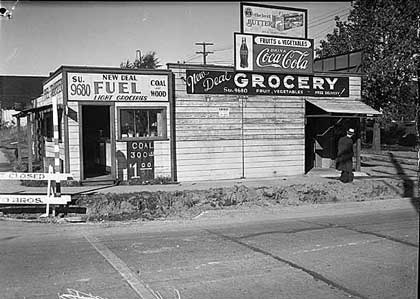
The New Deal Gas and Grocery, 1935, in the Ballard neighborhood of Seattle. The Cracking Depression and the New Deal inverse everyday life for people in both overt and subtle ways. Click epitome to overstate. (Courtesy of the Museum of History and Industry.)
The Great Depression transformed American social and political institutions and the means individual people thought about themselves and their relationship to the land and the world. Though no two people had the same understanding of the Low, everyone felt challenged and changed past the experience.
By 1932, 3 years after the initial crash, near thirty million Americans had lost their source of income, from unemployment or loss of a family unit breadwinner. This included more than a quarter of the population of Washington State. Of those lucky enough to take consistent work, many, perhaps most, took pay cuts or worked reduced schedules. Though in that location had been devastating economic depressions before, the 1930s crisis encompassed both urban and rural regions and devastated heart-class and working-class people akin.
LEARN More
• Bellingham Families during the Low: Changes in Everyday Life by Annie Morro
• The Banking Crunch of 1933: Seattle'south Survival during the Great Low Bank Closures, by Drew Powers
• Life in Raymond, Washington, during the early on years of the Bang-up Depression, by Jacob Monson
• The Great Depression in Kitsap County, 1929-1932, by Lauren Champa
• Emerging Opportunities in Dark Times: Japanese Americans in the Northwest, 1933-1934, by Yukio Maeda
•The 1932 Seattle Sports Scene: Helping the Emerald Metropolis through Hard Times, by Brian Harris
•Changing Advertisement Trends in the Seattle Times During the Bang-up Depression, by Yifeng Hua
•The Rainy City on the "Wet Coast": The Failure of Prohibition in Seattle, past Kayta Katherine Samuels
• Responding to Anti-Semitism in the Jewish Transcript: Seattle's Jews during America's Great Depression, by Stephanie Fajardo
• Murders, Gambling, and Suicides: Criminal offence in Seattle during the Depression, past Sarah Lawrence
• Challenging Gender Stereotypes during the Low: Female person Students at the University of Washington, by Nicolette Flannery
• The Boondocks the New Deal Built: Mason Metropolis, Yard Canyon Dam, and Visions of New Deal America, by Allison Lamb
However, the hurting was not equally distributed. Indeed some businesses did well fifty-fifty in the nighttime days of 1931 and 1932 and most families did not lose livelihoods or face privation. The impact varied according to industry, form, race, location, and luck. The construction trades and the lumber industry suffered greatly, and in the mill towns and lumber camps of Washington State, unemployment surged (see "Life in Raymond"). Workers in other kinds of factories often lost their jobs just those with advanced skills were less likely to be injure. White collar jobs fared better than blue collar jobs and those lucky enough to piece of work for a city, county, state, or at one of the military machine facilities generally held on to jobs. Subcontract families were mostly well positioned (encounter "Kitsap County"). Subcontract prices fell but not and so drastically that many Washington farmers were forced to sell or carelessness their homesteads. Indeed, the farm population grew during these hard times, as people who years earlier had left farmsteads for city jobs returned, moving in with relatives or friends.
Washington's tiny communities of color were striking especially hard. Employment discrimination doubled in intensity and African Americans and Asian Americans were pushed out of jobs, including domestic service and farm labor, that whites had previously shunned. Japanese Americans, the country's largest minority population, had congenital a thriving minor business organization sector in Seattle in the decades before the Groovy Depression. Now many of those residential hotels and restaurants struggled for customers (see "Emerging Opportunities in Night Times"). The crisis encouraged some families to leave. Seattle's Japanese American population fell during the 1930s, with some moving to rural areas and others to Nippon.
For Washington residents of all backgrounds who lost jobs, the challenges were daunting. With no unemployment insurance and typically with only one breadwinner, the loss of wages had an immediate and devastating upshot on families, often leading to eviction and homelessness. People squeezed in with relatives when possible or begged landlords to stay on rent-free. Wives and teenage children joined unemployed husbands in the desperate search for work. Minimal aid with food or rent was sometimes available from churches and charities, and in some counties, governments raised property taxes in an attempt to feed the hungry. The need far outstripped these local resource.
Sudden poverty produces psychological impairment. Families broke apart nether the strain. Divorces escalated, as did informal divorces as one partner or some other (mostly husbands) abased their family. Young people also fled, quitting school and setting off on the road. Wedlock rates and nativity rates plummeted as people worried that they could not afford to offset families. Acts of domestic violence multiplied and the suicide charge per unit increased dramatically (see "Murders, Gambling Suicide").
New Deal period
When Franklin Roosevelt assumed office in March 1933, the economy was nearly stalled. Congress quickly passed a sequence of emergency measures to rescue the banking organization, to send emergency aid to the states, and to begin to re-use the millions who were out of work. Federal funds to Washington State were funneled through the Washington Emergency Relief Assistants, a land agency that dispersed some coin directly to the poor in the class of cash grants while likewise launching dozens of public works projects that created new jobs. Soon in that location would exist more than jobs coordinated with federal agencies. The Civilian Conservation Corps (CCC) would employ thousands of young men in the forests and national parks of Washington Land. The Civil Works Adminstration ready small-scale public works jobs, while the Public Works Assistants planned huge new infrastructure projects that included Bonneville and K Canyon dams on the Columbia River (see "Mason City, Grand Cooley Dam"). In 1935 many of the jobs and structure programs were consolidated nether the Works Progress Administration (WPA).
With federal help, the land economy began a dramatic recovery, faster than many other states. By 1937, income payments in Washington (our best measure of economic activeness) had returned to 93 percent of the 1929 level. Nationally, the level was 88 per centum. Employment in the region's key industry, wood products, keyed the recovery. In 1937, there were nigh every bit many workers employed in the wood, sawmills, paper mills, furniture, and wood products factories every bit in 1929, although wages remained well beneath normal. Other parts of the economy had rebounded, though non and so dramatically (see "Economic science and Poverty").
New concerns/ new possibilities
After 1933, the expansion of the New Bargain meant that the authorities at present intervened much more than conspicuously in people's daily lives, employing them and giving them assist, as well as providing new forms of social insurance. The political mood also changed. A wave of labor strikes and unionization allowed for a new way of thinking nearly the power of ordinary people and racial and gender divisions. Some responded to the crunch by looking for different forms of social, political, and economic organization, and turned to radical— and sometimes, conservative —movements (come across "Strikes and Unions"). Ethnic communities, marginalized by race or religious categorizations, sought out unlike strategies for economic and social survival. A new kind of civil rights activism became axiomatic, especially in Seattle where information technology was centered in the African American and Filipino American communities and given voice in the Northwest Enterprise and Philippine-American Chronicle. Jewish organizations and activists played an important role in the civil rights struggles of the 1930s, as did the Communist Party and some left wing unions (see "Civil Rights").
Tardily in 1933, Utah ratified the 21st Amendment to the constitution, ending prohibition. The legal sale and consumption of alcohol and the reopening of bars and nightclubs inverse the contours of everyday life in dramatic ways, bringing drinking out of the shadows, making it cheaper, safer, and more widespread. It was simply ane of the notable cultural changes of the Neat Depression era. The repeal of prohibition changed how leisure was understood, while at the most intimate level, family relationships adjusted to the new weather of piece of work and unemployment that the Depression brought.
Gender expectations were changing. Massive unemployment disrupted the husband-as-sole-breadwinner ideal. Women entered the paid labor forcefulness at higher rates than always earlier, including married women and mothers. And some women reworked their understandings of their role in communities, in the nation, and in the earth. This included female students at the University of Washington (encounter "Challenging gender stereotypes")
Copyright (c) 2019, James Gregory
Adjacent: Civilisation and Arts During the Low
Click on the links below to read illustrated research reports on everyday life during Washinton'due south Great Depression:
 | Bellingham Families during the Low: Changes in Everyday Life by Annie Morro Whatcom Canton residents developed new social and familial roles in response to economical hardship. |
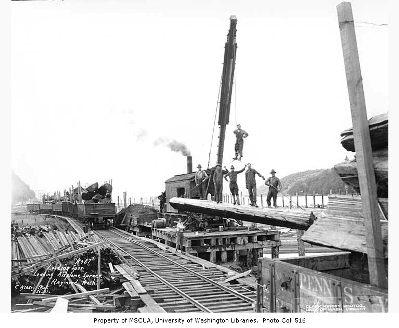 | Life in Raymond Washington During the Early Years of the Great Depression, 1929-1933 by Jacob Monson Like other resource dependent communities in Washington State, the town of Raymond struggled during the Great Depression. A local newspaper, the Raymond Advertiser, chronicled the challenges of the 1930's, while as well striving to maintain optimism and consumer confidence amid local residents. |
 | The Town the New Deal Built: Mason City, One thousand Canyon Dam, and Visions of New Deal America, past Allison Lamb Bricklayer Urban center, WA was built by federal New Deal funds and private contractors to house the workers and families who were edifice the G Canyon Dam, and was consciously promoted as an example of the social vision, technological capacity, and high standard of living that New Deal America aspired to. |
 | The 1932 Seattle Sports Scene: Helping the Emerald Urban center through Difficult Times, by Brian Harris Seattle rallied around its sports teams and prospective Olympic athletes as a symbol of community life and leisure during the Depression, despite loss of funds for many sports programs. |
 | Changing Advertising Trends in the Seattle Times During the Great Depression, by Yifeng Hua A statistical sample of consumer advertizing from 1928-1935 in the Seattle Times. |
 | The Rainy Metropolis on the "Wet Declension": The Failure of Prohibition in Seattle, by Kayta Katherine Samuels Prohibition failed to control the product, consumption, and enjoyment of alcohol in Seattle and the unabridged "moisture coast." |
 | Emerging Opportunities in Dark Times: Japanese Americans in the Northwest, 1933-1934, by Yukio Maeda During the Depression, many Japanese Americans in the Northwest began to embrace both Japanese and American cultures, nurtured cross-cultural social life, carved out economical sectors for themselves, and created political organizations with agile participation in local cities and towns |
 | Responding to Anti-Semitism in the Jewish Transcript: Seattle'southward Jews during America's Great Depression, past Stephanie Fajardo Seattle'southward Jewish customs sought out several strategies for responding to Anti-Semitism during the Great Depression through their newspaper. |
 | Murders, Gambling, and Suicides: Law-breaking in Seattle during the Depression, by Sarah Lawrence Crime was one way Seattle residents dealt with the Great Low. |
 | Challenging Gender Stereotypes during the Depression: Female person Students at the Academy of Washington, by Nicolette Flannery Female students in the 1930s challenged accepted ideas of women's pedagogy, participation in college athletics, and domestic and social responsibilities. |
 | The Slap-up Low in Kitsap County, 1929-1932 , past Lauren Champa During the early years of the Great Depression, many communities in Washington Land and beyond the nation struggled to survive economically. In Kitsap County, however, residents were able to rely upon a network of strong local businesses as well as a productive agronomical sector to help weather the finacial storm. |
 | The Banking Crisis of 1933: Seattle's Survival during the Great Depression Bank Closures, by Drew Powers The nationwide banking crisis of 1933, brought on past corruption, customer loan defaults, and an unstable banking organization brought beginning state-broad then nation-wide bank closures in 1933. Seattleites developed different strategies for surviving without greenbacks, while Roosevelt and Congress stabilized American commercialism and preserved public organized religion in American finance. |
Source: https://depts.washington.edu/depress/everyday_life.shtml

Post a Comment for "How Did the Great Depression Affect American Families"